


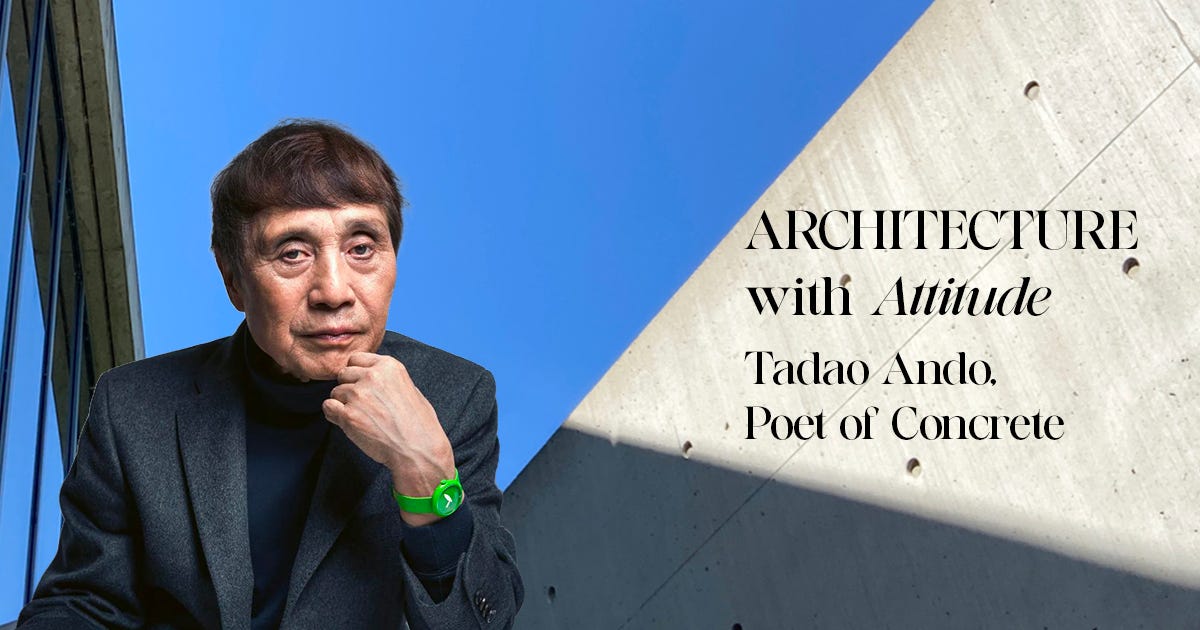
It happened twice, within the same year. Two encounters with the same architect’s work, and both times, the same physical reaction: silence. Not the absence of sound, but the kind of silence that takes hold of your body when something true appears.
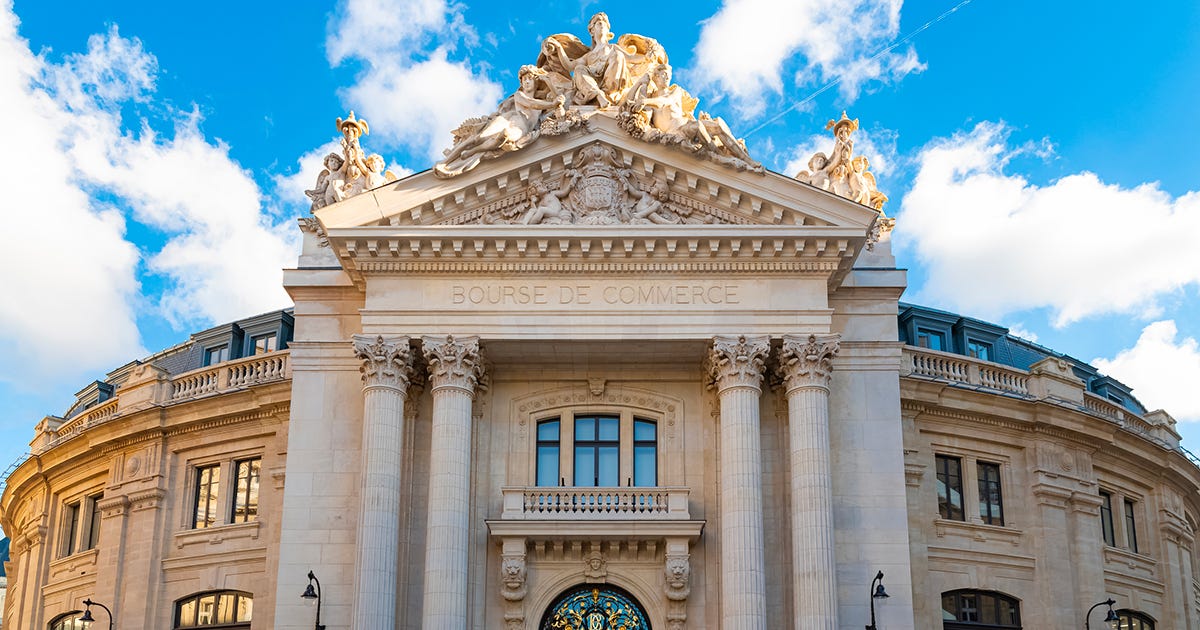
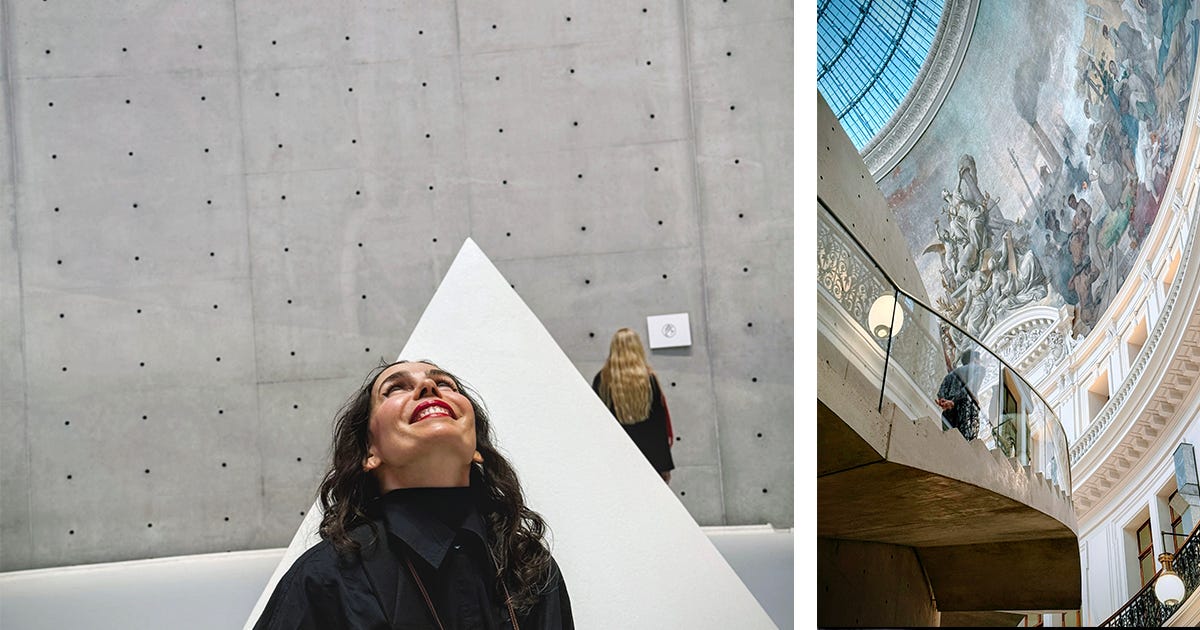
The first time, it was the Bourse de Commerce in Paris. I walked into that 18th-century rotunda, beneath the restored frescoes and the immense glass dome, and there it was: a cylinder of raw concrete, nine metres tall, twenty-nine metres wide, standing in the centre of the building like an act of quiet defiance. No ornament. No apology. Just this perfect, massive circle of béton brut, inserted into four centuries of Parisian architectural history as if it had always belonged there. The contrast should have felt violent. It felt right.
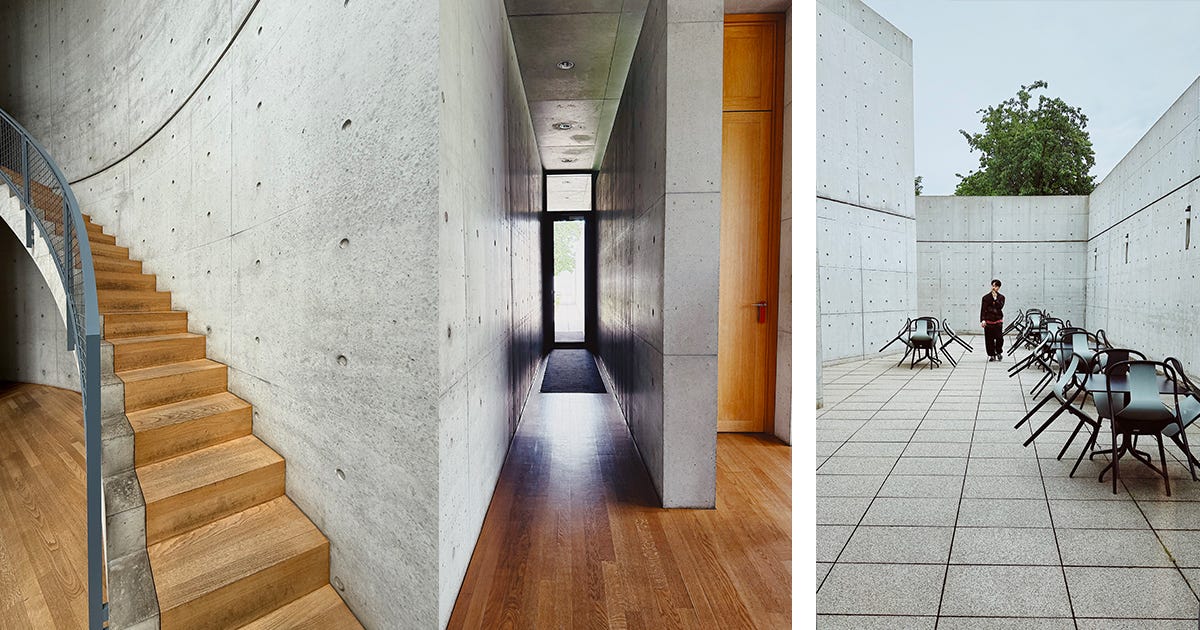
The second time, it was the Conference Pavilion on the Vitra Campus, in Weil am Rhein. I was on a guided tour, surrounded by the exuberant signatures of Gehry, Hadid, and Herzog & de Meuron. And then we reached a building that didn’t shout. Concrete walls so smooth they seemed almost tender.
Both buildings carry the signature of the same man: Tadao Ando. And both, in their radically different ways, confirmed what I have long believed: concrete is not a cold material. It is for me one of the most expressive, most emotional materials in architecture.
I had already explored this conviction in my article on Rudy Ricciotti, whose béton is Mediterranean, muscular. Ando’s concrete is something else entirely. It catches light. Two visions, two temperaments, but the same fundamental refusal to see concrete as merely functional, merely grey, merely brutal.
The Boxer Who Became an Architect
Tadao Ando was born in Osaka in 1941. He grew up in a working-class neighbourhood, raised by his grandmother. He never attended architecture school. He never had a mentor, a master, or an institutional pathway. What he had was a fierce, almost ferocious curiosity - and, before architecture, a career as a professional boxer.
The boxing detail is not anecdotal. It tells you everything about the man: discipline, solitude, physical intelligence, the willingness to take hits and keep standing. These are not metaphors. They are the foundations of an architectural practice that has, for over fifty years, refused every shortcut.
In the early 1960s, Ando discovered a book by Le Corbusier in a second-hand bookshop in Osaka. He was so struck by the drawings that he traced them obsessively, trying to understand how spaces could be conceived through lines on paper. He couldn’t afford architecture school, so he did what few would dare: he taught himself. He read. He studied. And then, between 1962 and 1969, he travelled through Japan, Europe, Africa, the United States, and Asia, visiting buildings the way others visit temples.
In 1969, he returned to Osaka and founded Tadao Ando Architect & Associates. He was twenty-eight years old. He had no degree, no connections, no clients. He had something better: a vision so clear it would take the world decades to fully understand it.
Concrete as a Language of the Soul
To understand Ando, you must understand his relationship with concrete. It is not a stylistic choice. It is not an aesthetic preference. It is a philosophy.
Ando’s concrete - his famous fair-faced reinforced concrete - is poured into wooden formwork panels designed to the exact dimensions of a traditional Japanese tatami mat. Each panel bears six anchor holes where the bolts hold the shuttering together. When the formwork is removed, the concrete surface retains these marks: the grid of the panels, the small circles of the bolt holes, arranged with mathematical precision across the wall. Most architects would fill these holes, smooth the surface, cover the evidence of construction. Ando leaves them visible. They become his signature, a declaration that the process of making is as beautiful as the finished object.
The wood used for his formwork is specially varnished, which gives the concrete an extraordinary quality when it sets: smooth, almost silken to the touch, with a luminous warmth that changes throughout the day as light moves across its surface. People who have never touched an Ando wall imagine concrete as rough and cold. Those who have describe something closer to stone that has been polished by centuries of water.
Where Light Enters
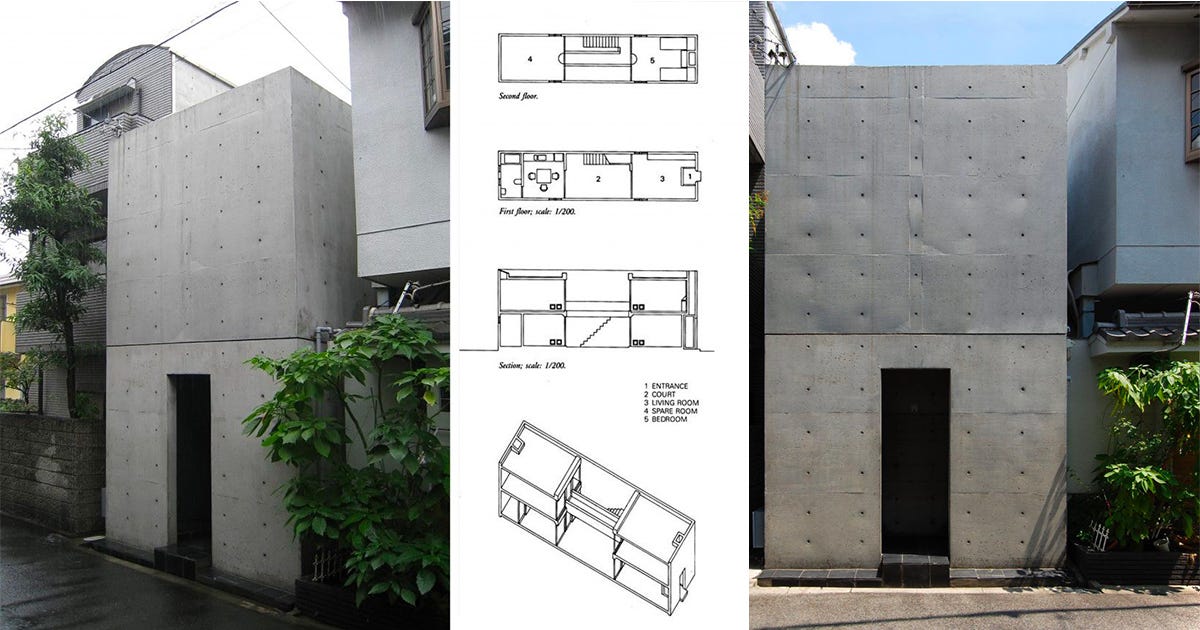
Ando’s earliest masterpiece is tiny. The Row House in Sumiyoshi, completed in 1976 in a dense Osaka neighbourhood, is barely more than a narrow concrete box inserted between two traditional wooden houses. Its radical gesture: an open courtyard at its centre, exposed to rain and sky, that forces the inhabitants to walk outside to move between rooms. Architecture critics were scandalised. A house where you need an umbrella to go from the bedroom to the bathroom? Ando’s response was characteristically blunt: he was not interested in convenience. He was interested in making people feel the weather, the seasons, the passage of time, every single day.
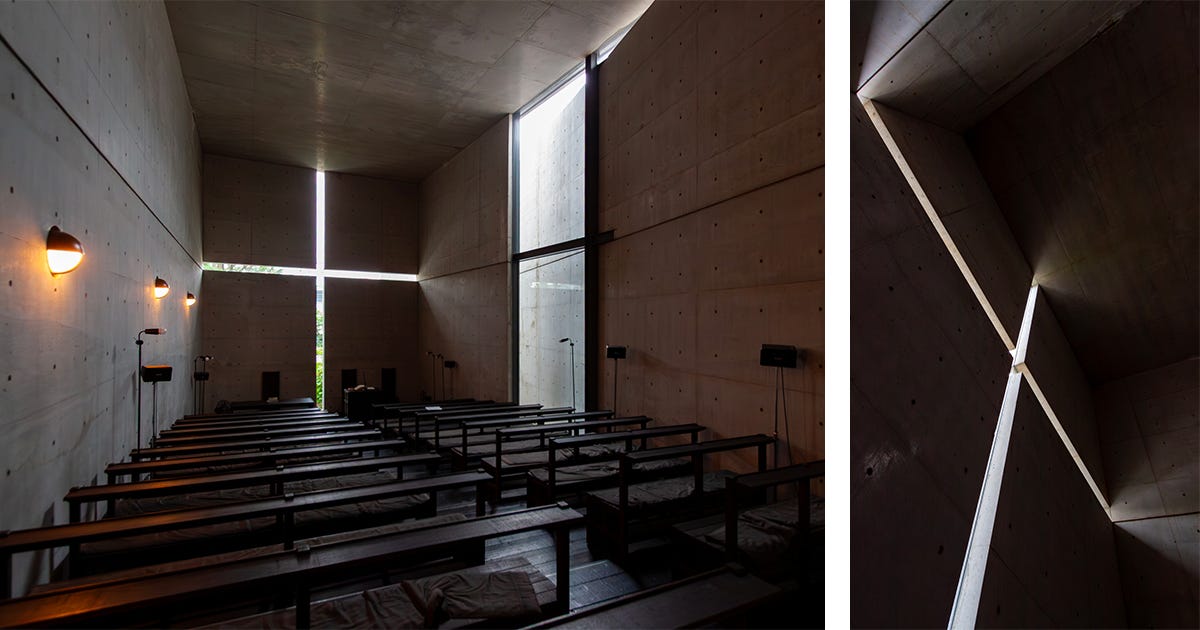
This conviction that architecture must reconnect humans to the elemental reaches its most transcendent expression in the Church of the Light, completed in 1989 in Ibaraki, a suburb of Osaka. A small, austere concrete box. No decoration. No colour. And in the wall behind the altar, a cruciform slot cut clean through the concrete, from floor to ceiling and wall to wall. Through this opening, daylight pours in, not as gentle illumination but as a blade of light that carves the darkness. The cross is not painted, not sculpted, not gilded. It is absence. It is void. It is pure light defining pure form.
Ando once said: “I do not believe architecture has to speak too much. It should remain silent and let nature in the guise of sunlight and wind speak.”
This is the core of his philosophy: architecture as a frame for the invisible. Concrete as the vessel. Light and silence as the true materials.
Naoshima: An Island Transformed
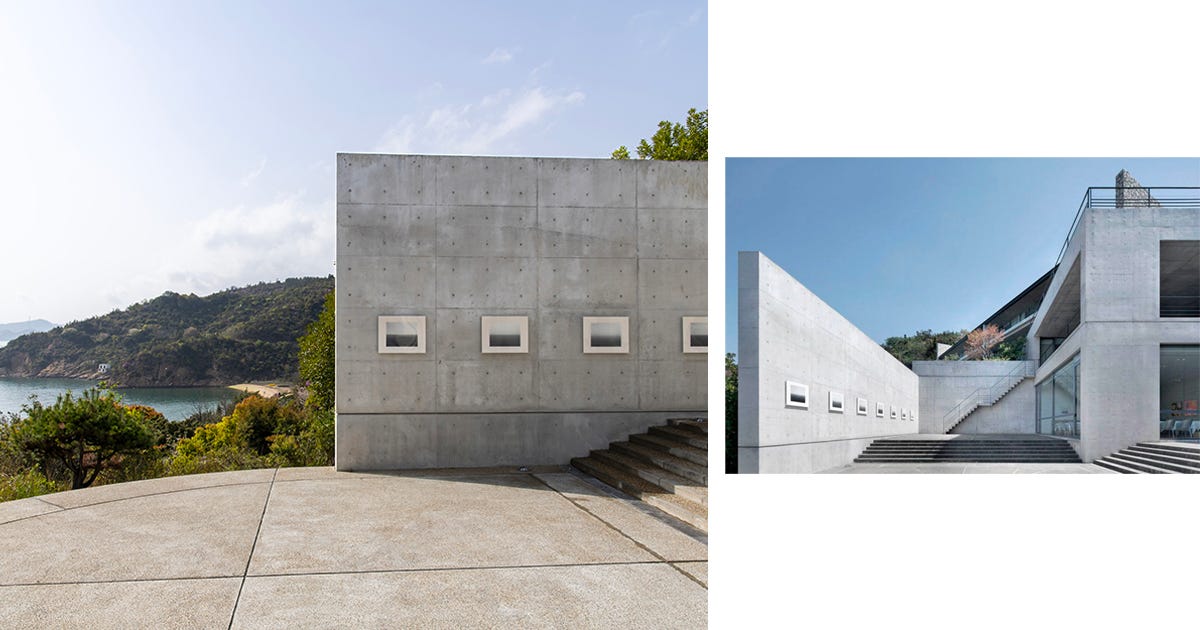
If one project encapsulates Ando’s vision at its most ambitious, it is Naoshima, a small island in Japan’s Seto Inland Sea that, over thirty-seven years, he has transformed into one of the world’s most extraordinary art destinations.
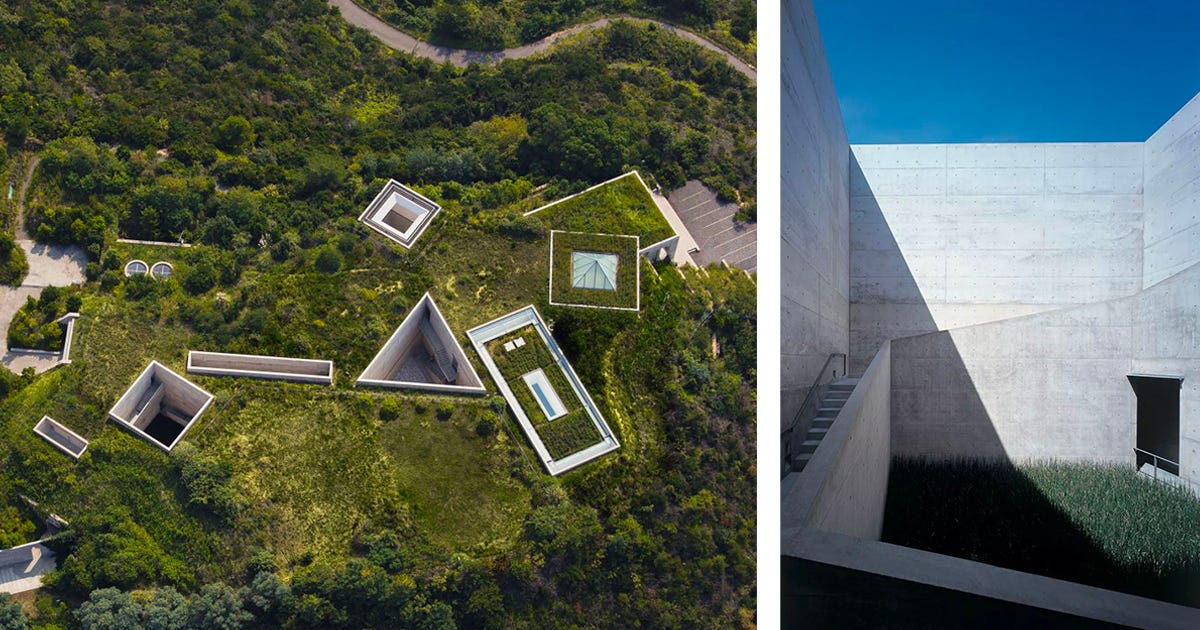
It began in the late 1980s with the Benesse House Museum, a building that is simultaneously a museum and a hotel, where guests sleep among the artworks. Then came the Chichu Art Museum, completed in 2004 — a structure built almost entirely underground, invisible from the surface, its galleries illuminated solely by natural light channelled through geometric openings in the earth. The museum houses just three artists — Claude Monet, Walter De Maria, and James Turrell — in spaces so precisely calibrated to each work that architecture and art become indistinguishable.
In 2025, the Naoshima New Museum of Art opened, adding another chapter to this ongoing dialogue between island, art, and concrete. For Ando, Naoshima is not a project. It is a life’s work — proof that architecture can transform not just a building but an entire landscape, an entire community, an entire way of seeing.
The Bourse de Commerce: A Conversation Across Centuries
When François Pinault chose Ando to transform the Bourse de Commerce into a museum for his contemporary art collection, he was asking for something nearly impossible: to insert a radically modern intervention into one of Paris’s most historically layered buildings - a structure that carries the memory of Catherine de Médicis’s 16th-century column, an 18th-century circular grain hall, a 19th-century iron and glass dome, and elaborate painted murals depicting France’s commercial empire.
Ando’s answer was the cylinder. A circle of cast-in-place concrete, twenty-nine metres wide and nine metres tall, placed at the exact centre of the rotunda, beneath the dome. No structural connection to the existing walls. No disruption of the historical surfaces. Just this massive, serene presence — like a thought materialised in space.
For Ando, the circle holds a specific meaning rooted in Japanese philosophy: it represents both mu (nothingness, the void) and the whole. In the Bourse, this duality is palpable. The cylinder simultaneously empties the space and completes it. It creates a new interior - contemplative, focused, modern - while honouring everything that surrounds it: the murals above, the dome beyond, four centuries of Parisian history radiating outward.
Concrete staircases spiral around the cylinder’s exterior like a thin peel of fruit, rising from the basement to the upper galleries, offering changing perspectives on the building’s layers as you ascend. The Bouroullec brothers designed the luminaires. Michel and Sébastien Bras conceived the restaurant. But the emotional anchor is Ando’s circle: still, silent, absolute.
Still Building, Still Drawing
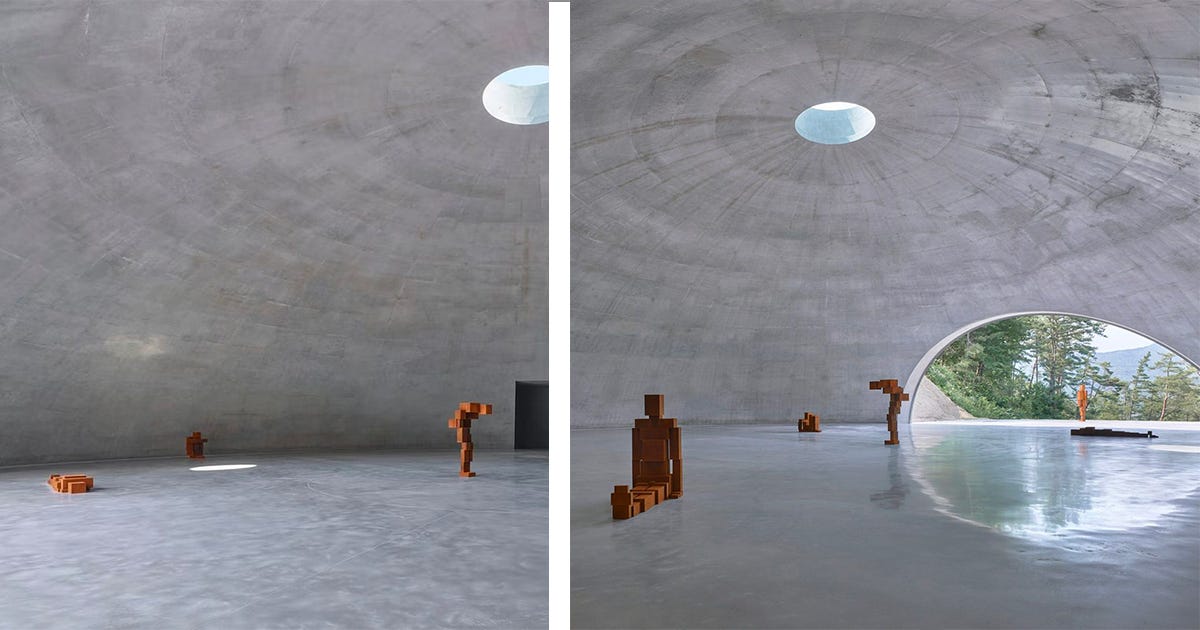
At eighty-four, Tadao Ando shows no sign of slowing down. In 2025, he unveiled the design for the Dubai Museum of Art (DUMA), a curved concrete form inspired by the pearl, set to rise on the waters of Dubai Creek. In Tashkent, his National Museum of Uzbekistan is under construction, with an opening planned for 2028. In South Korea, he collaborated with sculptor Antony Gormley on a twenty-five-metre subterranean concrete dome at Museum SAN - a space where visitors descend into the earth to encounter both art and architecture through a single oculus of light.
The major retrospective exhibition Youth, held at the VS. venue in Grand Green Osaka from March 2025, gathered approximately sixty architectural projects and over two hundred and thirty works - sketches, models, and immersive installations, including a life-size recreation of the Church on the Water. The exhibition’s title is characteristically provocative: at eighty-four, Ando insists that youth is not an age but an attitude - a refusal to stop questioning, learning, fighting.
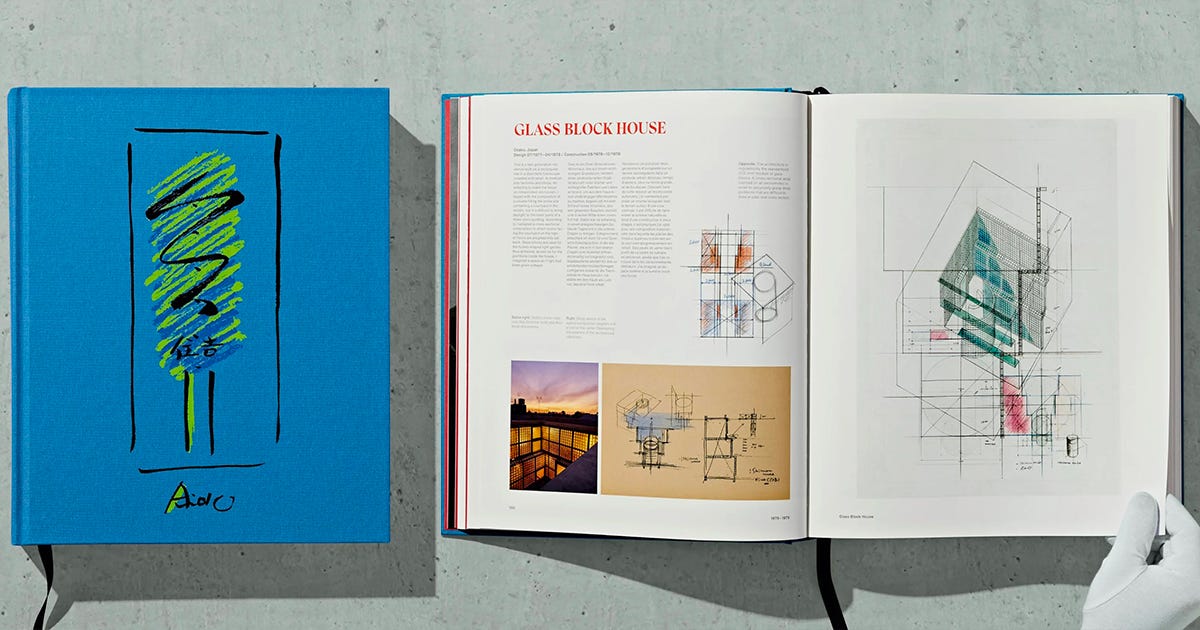
And then there is the book. Published by Taschen in November 2025, Tadao Ando: Sketches, Drawings, and Architecture is a 594-page volume gathering over 750 sketches, models, and technical plans spanning five decades. It reveals the intimate, obsessive process behind the architecture: the quick pencil lines, the colour studies, the plans that evolve from instinct to precision. In his foreword, Ando writes with characteristic directness that he does not trust digital media, that the hand-drawn line carries a vitality that no computer can replicate, and that he will continue to draw by hand “to the very end.”
There is something profoundly moving about this: one of the world’s greatest living architects, a man who has built on four continents, who has won the Pritzker Prize (1995), the RIBA Royal Gold Medal (1997), and the AIA Gold Medal (2002), still sitting at his desk in Osaka with a pencil and a sheet of paper, believing that architecture begins in the tremor of a hand.
The Architecture of Conviction
What draws me to Tadao Ando, beyond the beauty of his buildings, beyond the mastery of his concrete, is something that resonates deeply with everything I explore through Celinescape: the idea that style is not surface. It is structure. It is the visible expression of an inner conviction so complete that it shapes everything it touches.
Ando built his entire career without a diploma, without a movement, without a manifesto written by others. He is his own school. His style, if we can even call it that, is not something he adopted. It is something he became, through decades of discipline, solitude, travel, and an almost monastic devotion to a few essential materials: concrete, light, water, wind.
In a world that worships novelty, Ando returns, again and again, to the same elements, and each time, finds something new within them. This is not repetition. It is depth. It is the difference between someone who collects styles and someone who inhabits one.
Standing inside that concrete cylinder at the Bourse de Commerce, or following the meditation path at Vitra, I felt what I always feel in the presence of true creative conviction: that the space was not just designed. It was meant. Every surface, every shadow, every silence was intentional, not in a controlling way, but in the way a poem is intentional: each word chosen, each pause earned.
Follow me on Instagram @celinescape_