


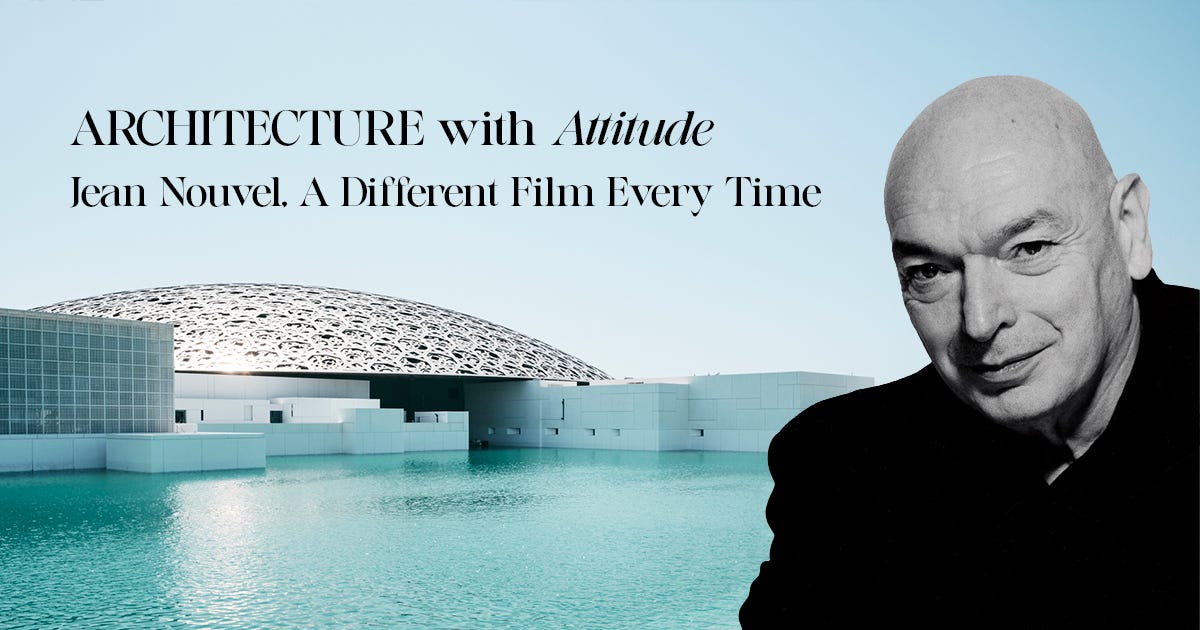
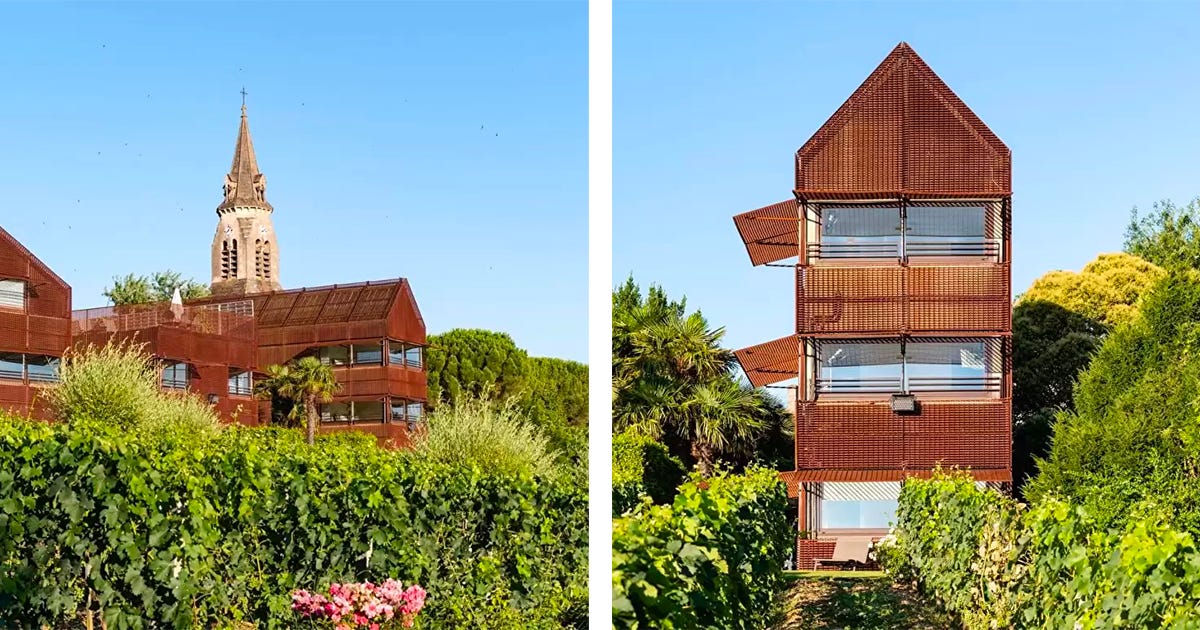
I discovered Jean Nouvel the way you discover certain architects. Not through a magazine or a lecture, but through the shock of walking into one of their buildings unprepared. It was the late nineties, maybe 2000. I was staying at the Hotel Saint-James in Bouliac, perched above the vineyards outside Bordeaux. I had no idea what to expect. What I found was a place unlike any hotel I had ever seen: four low volumes with plain roofs, bare concrete floors, waxed plaster walls stripped of any ornament, and rust-coloured metal screens that filtered the light like the old tobacco-drying barns of the region. The furniture had been designed by Nouvel himself. Everything was reduced to the essential. And yet, far from feeling austere, the hotel felt alive with restraint. I remember standing at the window, looking out at the Garonne valley through those rusted grilles, and thinking: this is what happens when an architect trusts the landscape more than decoration.
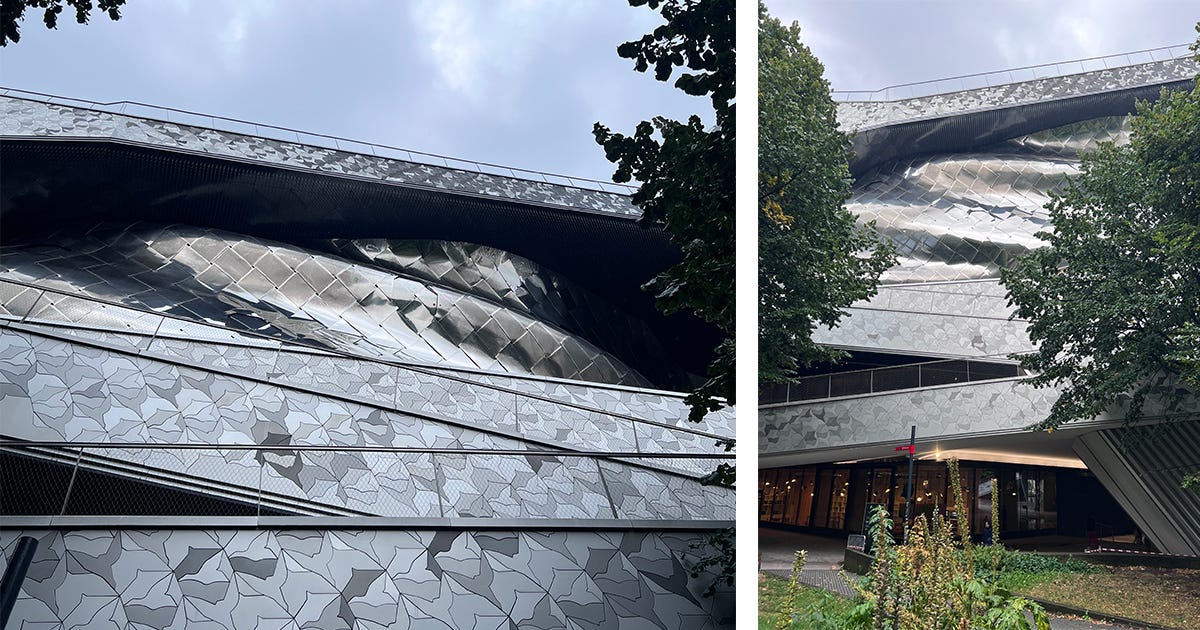
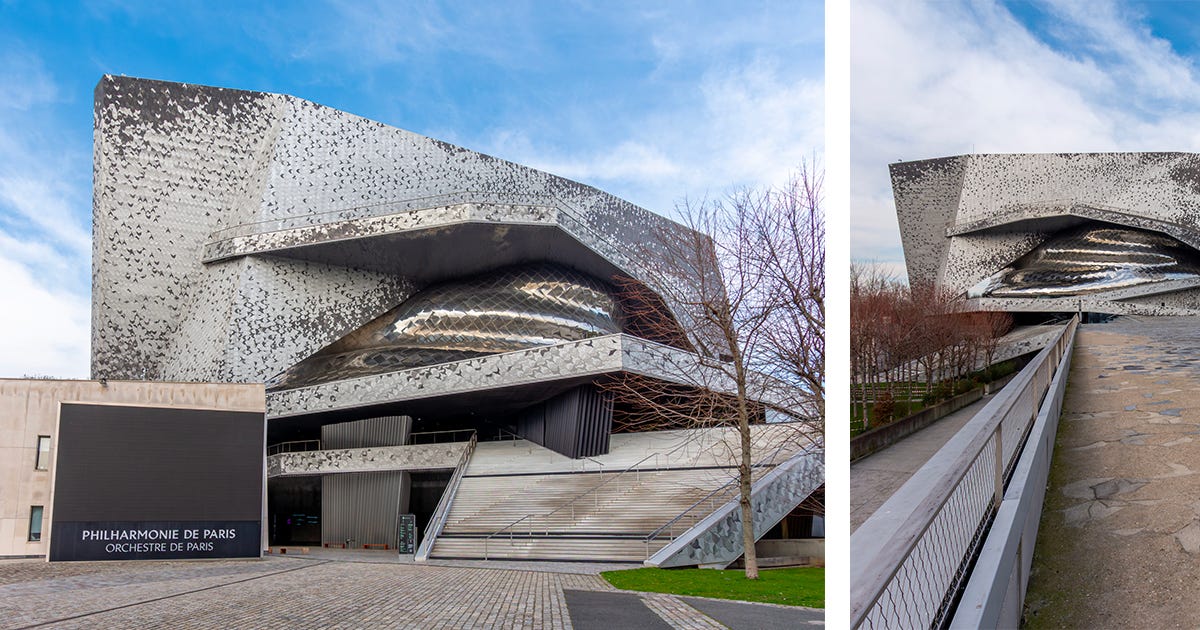
That experience stayed with me for years, quietly. Then, about two years ago, I stood before the Philharmonie de Paris and felt something similar — that same jolt of recognition, that same sense of a building that refuses to be ordinary. The fractured aluminium panels shimmering in the afternoon light, the way the structure seemed to rise from the Parc de la Villette like a geological formation rather than something built by human hands. I never went inside. I didn’t need to. The exterior alone told me everything about the ambition, the audacity, and the uncompromising vision of the man who conceived it.
Two encounters, twenty years apart. Two buildings that could not look more different. And yet, both unmistakably the work of the same mind. A mind that refuses repetition, that insists every building must be invented from scratch, for its place and its time. This is what draws me to Jean Nouvel, and why he belongs in this series alongside Rudy Ricciotti’s muscular Mediterranean concrete and Tadao Ando’s silent poetry of light. Where Ricciotti fights, where Ando meditates, Nouvel disappears. His greatest ambition is to make architecture that seems inevitable — as though it had always been there.
The Rebel Who Refused a Style
Jean Nouvel was born on 12 August 1945 in Fumel, a small town in the Lot-et-Garonne, the son of two teachers. He studied at the École des Beaux-Arts in Paris, where he graduated in 1972, and worked as assistant then project manager under Claude Parent and Paul Virilio — the architects who theorised the “oblique function,” challenging the tyranny of horizontal and vertical planes. That early exposure to radical thinking shaped Nouvel’s DNA. From the very beginning, he rejected the idea that an architect should develop a recognisable signature and apply it everywhere.
This refusal is his signature. Every Nouvel building is conceived as a singular response to a specific place, a specific programme, a specific moment. He has compared himself to a filmmaker who makes a different film each time: the actors change, the story changes, the visual language changes, but the directorial intelligence remains. The Pritzker jury, awarding him the prize in 2008, praised his “persistence, imagination, exuberance, and, above all, an insatiable urge for creative experimentation.”
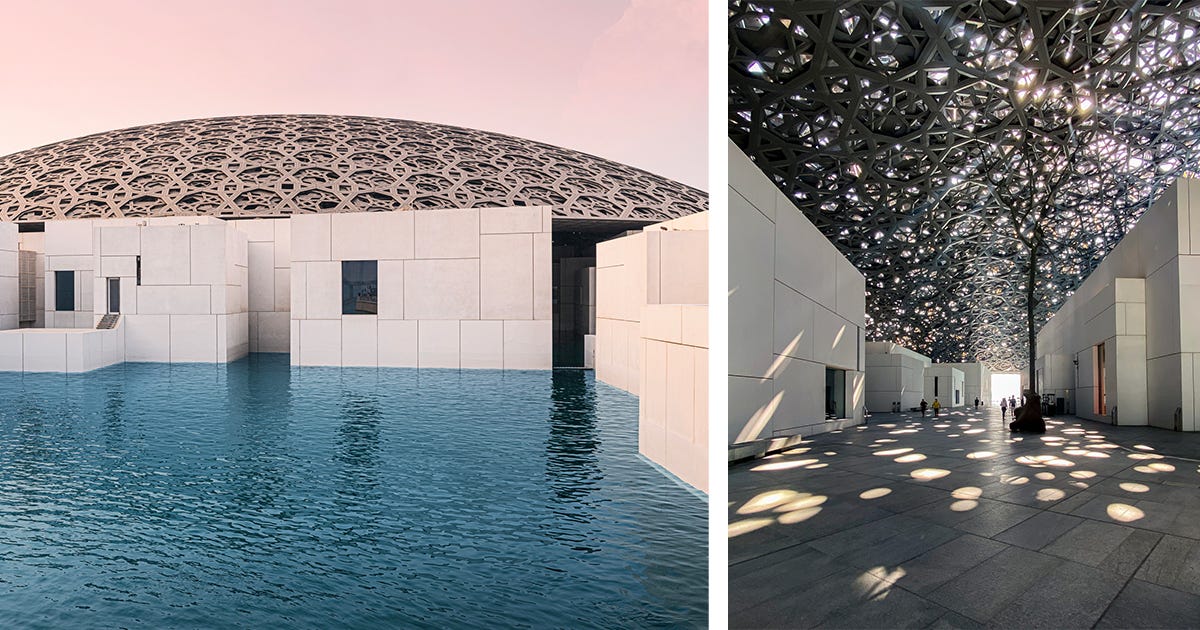
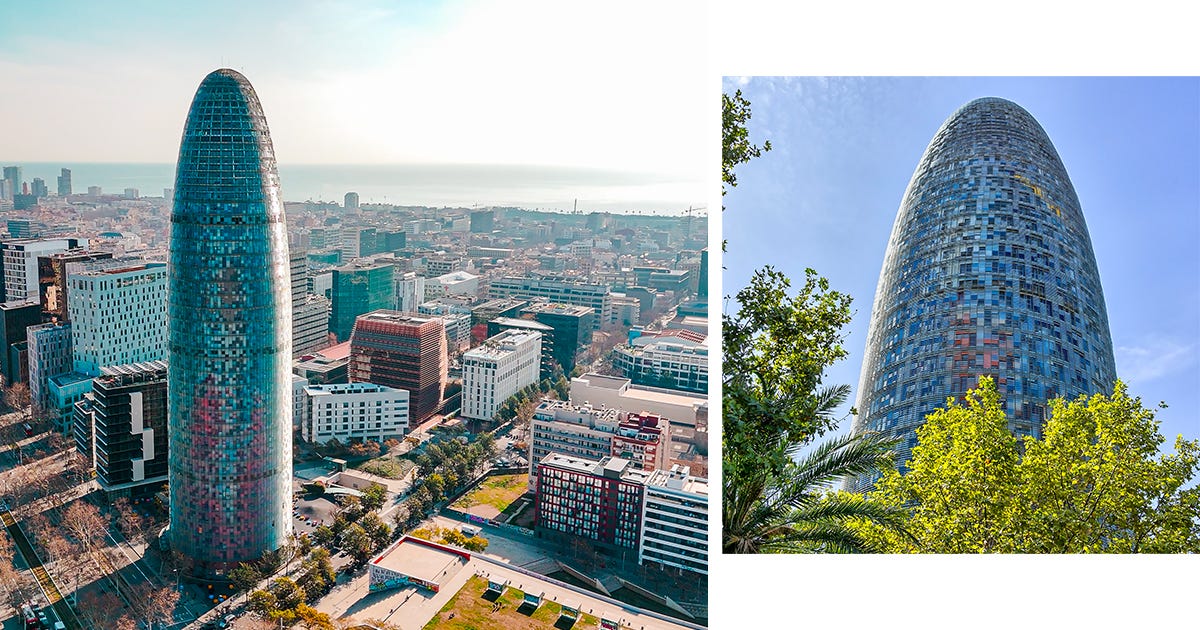
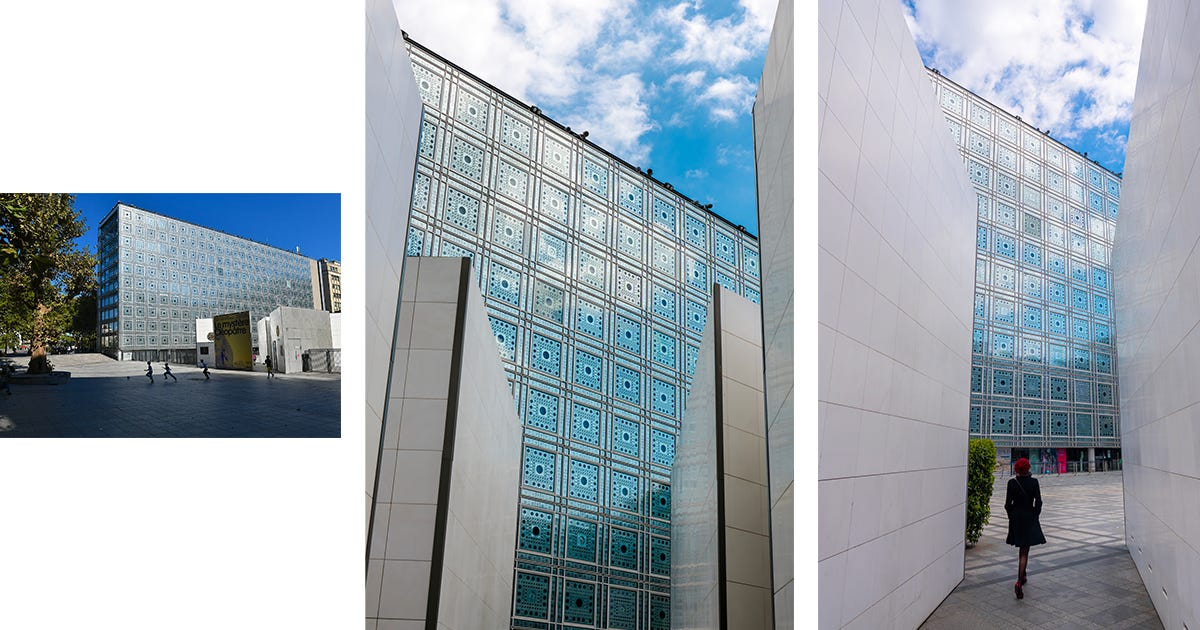
What this means in practice is that you cannot predict what a Nouvel building will look like. The Institut du Monde Arabe in Paris (1987) — his first international breakthrough — features a south facade of 240 mechanical mashrabiyas, photo-sensitive apertures inspired by Islamic geometric screens that open and close with the light like a camera iris. The Fondation Cartier (1994), a few kilometres away, is the exact opposite: a glass box so transparent that the surrounding trees seem to grow through it, blurring every boundary between inside and out, built and natural. Torre Agbar in Barcelona (2005) is a luminous bullet of coloured glass. The Musée du Quai Branly (2006) hides behind a living wall of vegetation. The Louvre Abu Dhabi (2017) shelters beneath a vast dome of 7,850 star-shaped openings that filter sunlight into what Nouvel calls a “rain of light,” evoking the shade of palm fronds in an oasis.
Each project is a new world. Each one listens to its site and its culture before speaking.
Light as the True Material
If there is one thread that runs through Nouvel’s work, it is light. Not light as decoration or effect, but light as the primary material of architecture — more important than steel, glass, or concrete. At the Institut du Monde Arabe, light is controlled by mechanical apertures. At the Fondation Cartier, light passes unfiltered through layers of glass and reflection. At the Louvre Abu Dhabi, light is fragmented into thousands of moving points, a celestial canopy that shifts with the hours.
In a recent interview, Nouvel spoke about what he calls the “aesthetic of the miracle” — the moment when technology and materiality combine to produce something that transcends function and touches emotion. This is not architecture as spectacle. It is architecture as atmosphere, as feeling, as the quiet transformation of space through the passage of the sun.
I felt this acutely standing before the Philharmonie. The aluminium panels that clad its surface are not simply decorative; they catch and scatter light differently at every hour, making the building appear to shift and breathe. Nouvel conceived the Philharmonie as a “musical landscape” — a building whose very skin would vibrate with reflected sound and light. The long and painful dispute over its execution (budget overruns, construction changes made without his consent, years of legal battles) has since been resolved, and Nouvel has returned to oversee a programme of complementary works. As the Philharmonie celebrated its tenth anniversary in January 2025, even its critics acknowledged that the building has become unanimously recognised, both in France and abroad. Sometimes the vision outlasts the conflict.
A New Chapter: The Fondation Cartier at Palais-Royal
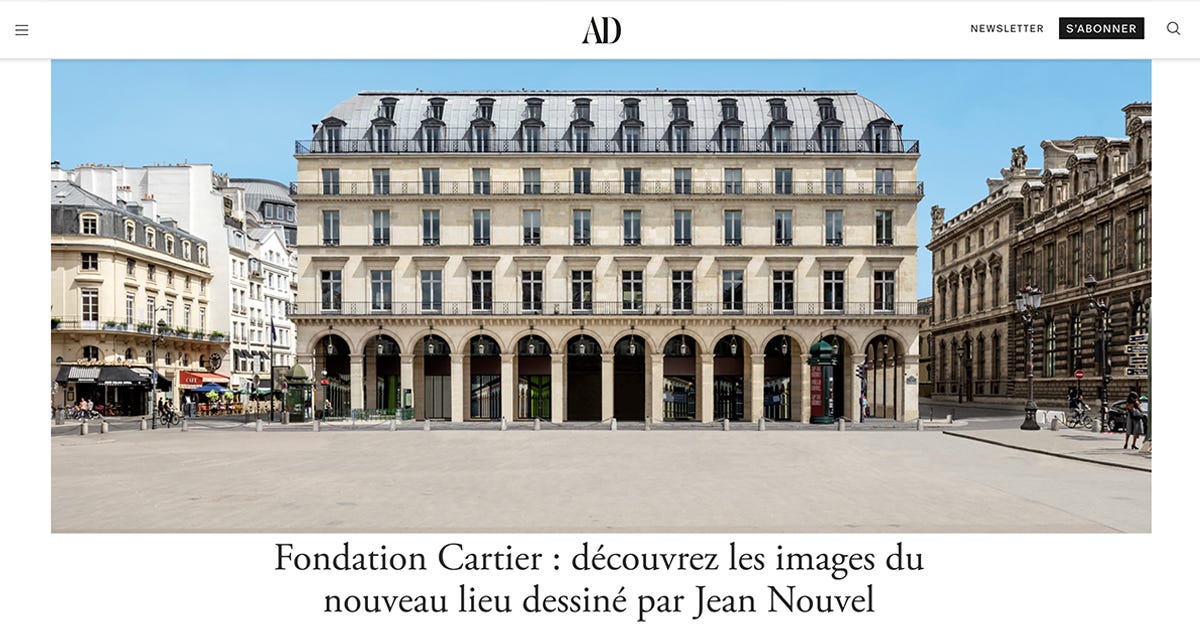
As I write this in May 2026, Nouvel’s most significant late-career project is unfolding in the heart of Paris. The Fondation Cartier pour l’art contemporain has moved from its beloved glass building on Boulevard Raspail to a new, far more ambitious space designed by Nouvel at Place du Palais-Royal. The former Louvre des Antiquaires has been transformed into 8,500 square metres of public space and 6,500 square metres of exhibition area, with five mobile platforms, operable glass roofs, and facades that open directly onto Rue de Rivoli. The inaugural exhibition, “Exposition Générale,” brings together six hundred works by one hundred artists and runs through August 2026.
It is, in many ways, the culmination of everything Nouvel has explored since the original Fondation Cartier thirty years ago: transparency, permeability, the dissolution of boundaries between art, city, and sky. A building that breathes with its surroundings rather than enclosing itself against them.
And in a beautiful coincidence of timing, the Hotel Saint-James in Bouliac — that small, radical hotel where I first encountered Nouvel’s work — is reopening this very month, on 14 May 2026, after three years of renovation. The building has been restored and elevated to five-star status, with a second phase planned that includes forest villas and a spa. The architecture that marked me twenty years ago will welcome a new generation of visitors. Some buildings, like the ideas behind them, refuse to age.
The Architecture of Listening
What draws me to Jean Nouvel, beyond the brilliance of individual buildings, is something that connects deeply with everything I explore through Celinescape: the conviction that style is not a formula you repeat but a response you invent. Nouvel does not impose a language on a place. He listens — to the site, to the culture, to the light — and then he answers. Each answer is different. Each one is true.
In a world that increasingly rewards uniformity and efficiency, Nouvel’s work is a reminder that architecture can still surprise, still move, still disappear into its own rightness. His buildings ask you to look again, and again, and each time you see something new.
Standing before the Hotel Saint-James, before the Philharmonie or the new Fondation Cartier, you feel what I always feel in the presence of true creative conviction: that the space was meant. Not designed. Meant.
Follow me on Instagram @celinescape_